
pertpy.tools.Scgen#
- class Scgen(adata, n_hidden=800, n_latent=100, n_layers=2, dropout_rate=0.2, **model_kwargs)[source]#
JAX implementation of scGen for batch removal and perturbation prediction.
The latent space supports vector arithmetic: the difference between the latent means of a stimulated and a control population, added to unperturbed cells of another cell type, predicts that cell type’s response.
Attributes table#
|
|
Whether |
|
|
Methods table#
|
Removes batch effects. |
|
Get decoded expression. |
|
Return the latent representation for each cell. |
|
Load a model saved with |
|
Plots the dot product between delta and latent representation of a linear classifier. |
|
Plots mean matching for a set of specified genes. |
|
Plots variance matching for a set of specified genes. |
|
Predicts the cell type provided by the user in stimulated condition. |
|
Save the trained model to a directory. |
|
Register the fields that scGen reads from |
|
Train the model. |
Attributes#
- Scgen.batch_key#
adata.obscolumn holding the condition or batch.
- Scgen.labels_key#
adata.obscolumn holding the cell type.
Methods#
- Scgen.batch_removal(adata=None)[source]#
Removes batch effects.
- Parameters:
adata (
AnnData|None, default:None) – AnnData object with equivalent structure to initial AnnData. If None, defaults to the AnnData object used to initialize the model. Must have been setup with batch_key and labels_key, corresponding to batch and cell type metadata, respectively.- Return type:
- Returns:
A corrected ~anndata.AnnData object. AnnData of corrected gene expression in adata.X and corrected latent space in adata.obsm[“latent”]. A reference to the original AnnData is in corrected.raw if the input adata had no raw attribute.
Examples
>>> import pertpy as pt
>>> data = pt.dt.kang_2018()
>>> pt.tl.Scgen.setup_anndata(data, batch_key="label", labels_key="cell_type")
>>> model = pt.tl.Scgen(data)
>>> model.train(max_epochs=10, batch_size=64, early_stopping=True, early_stopping_patience=5)
>>> corrected_adata = model.batch_removal()
- Scgen.get_decoded_expression(adata=None, indices=None, batch_size=1024, *, seed=0)[source]#
Get decoded expression.
- Parameters:
adata (
AnnData|None, default:None) – AnnData with the same variables as the AnnData the model was initialized with. If None, that AnnData is used.indices (
Sequence[int] |None, default:None) – Indices of cells to use. If None, all cells are used.batch_size (
int, default:1024) – Minibatch size used while decoding.seed (
int, default:0) – Seed for the latent sampling.
- Return type:
- Returns:
Decoded expression for each cell.
Examples
>>> import pertpy as pt
>>> data = pt.dt.kang_2018()
>>> pt.tl.Scgen.setup_anndata(data, batch_key="label", labels_key="cell_type")
>>> model = pt.tl.Scgen(data)
>>> model.train(max_epochs=10, batch_size=64, early_stopping=True, early_stopping_patience=5)
>>> decoded_X = model.get_decoded_expression()
- Scgen.get_latent_representation(adata=None, indices=None, give_mean=True, n_samples=1, batch_size=1024, *, seed=0)[source]#
Return the latent representation for each cell.
- Parameters:
adata (
AnnData|ndarray|None, default:None) – AnnData with the same variables as the AnnData the model was initialized with. If None, that AnnData is used. A dense expression matrix is also accepted.indices (
Sequence[int] |None, default:None) – Indices of cells to use. If None, all cells are used.give_mean (
bool, default:True) – Whether to return the mean of the latent distribution rather than a sample.n_samples (
int, default:1) – Number of latent samples to draw whengive_meanis False.batch_size (
int, default:1024) – Minibatch size used while encoding.seed (
int, default:0) – Seed for the latent sampling.
- Return type:
- Returns:
Low-dimensional representation for each cell.
Examples
>>> import pertpy as pt
>>> data = pt.dt.kang_2018()
>>> pt.tl.Scgen.setup_anndata(data, batch_key="label", labels_key="cell_type")
>>> model = pt.tl.Scgen(data)
>>> model.train(max_epochs=10, batch_size=64, early_stopping=True, early_stopping_patience=5)
>>> latent_X = model.get_latent_representation()
- classmethod Scgen.load(dir_path, adata=None)[source]#
Load a model saved with
save().- Parameters:
- Return type:
- Returns:
The loaded model.
Examples
>>> import pertpy as pt
>>> model = pt.tl.Scgen.load("scgen_model")
- Scgen.plot_binary_classifier(scgen, adata, delta, ctrl_key, stim_key, *, fontsize=14, return_fig=False)[source]#
Plots the dot product between delta and latent representation of a linear classifier.
Builds a linear classifier based on the dot product between the difference vector and the latent representation of each cell and plots the dot product results between delta and latent representation.
- Parameters:
scgen (
Scgen) – ScGen object that was trained.adata (
AnnData|None) – AnnData object with equivalent structure to initial AnnData. If None, defaults to the AnnData object used to initialize the model. Must have been set up with batch_key and labels_key, corresponding to batch and cell type metadata, respectively.delta (
ndarray) – Difference between stimulated and control cells in latent spacectrl_key (
str) – Key for control part of the data found in condition_key.stim_key (
str) – Key for stimulated part of the data found in condition_key.fontsize (
float, default:14) – Set the font size of the plot.return_fig (
bool, default:False) – if True, returns figure of the plot, that can be used for saving.
- Return type:
- Returns:
If return_fig is True, returns the figure, otherwise None.
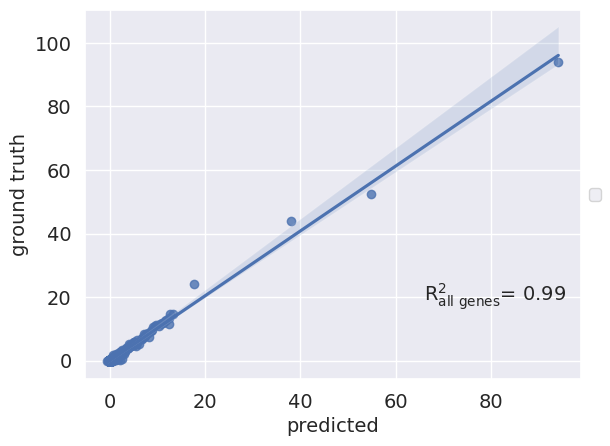
- Scgen.plot_reg_mean_plot(adata, condition_key, axis_keys, labels, *, gene_list=None, top_100_genes=None, verbose=False, legend=True, title=None, x_coeff=0.3, y_coeff=0.8, fontsize=14, show=False, save=None, **kwargs)[source]#
Plots mean matching for a set of specified genes.
- Parameters:
adata – AnnData object with equivalent structure to initial AnnData. If None, defaults to the AnnData object used to initialize the model. Must have been setup with batch_key and labels_key, corresponding to batch and cell type metadata, respectively.
condition_key (
str) – The key for the conditionaxis_keys (
dict[str,str]) – Dictionary of adata.obs keys that are used by the axes of the plot. Has to be in the following form: {x: Key for x-axis, y: Key for y-axis}.labels (
dict[str,str]) – Dictionary of axes labels of the form {x: x-axis-name, y: y-axis name}.gene_list (
list[str] |None, default:None) – list of gene names to be plotted.top_100_genes (
list[str] |None, default:None) – List of the top 100 differentially expressed genes. Specify if you want the top 100 DEGs to be assessed extra.verbose (
bool, default:False) – Specify if you want information to be printed while creating the plot.legend (
bool, default:True) – Whether to plot a legend.title (
str|None, default:None) – Set if you want the plot to display a title.x_coeff (
float, default:0.3) – Offset to print the R^2 value in x-direction.y_coeff (
float, default:0.8) – Offset to print the R^2 value in y-direction.fontsize (
float, default:14) – Fontsize used for text in the plot.show (
bool, default:False) – if True, will show to the plot after saving it.save (
str|bool|None, default:None) – Specify if the plot should be saved or not.**kwargs
- Return type:
- Returns:
Returns R^2 value for all genes and R^2 value for top 100 DEGs if top_100_genes is not None.
Examples
>>> import pertpy as pt
>>> data = pt.dt.kang_2018()
>>> pt.tl.Scgen.setup_anndata(data, batch_key="label", labels_key="cell_type")
>>> scg = pt.tl.Scgen(data)
>>> scg.train(max_epochs=10, batch_size=64, early_stopping=True, early_stopping_patience=5)
>>> pred, delta = scg.predict(ctrl_key='ctrl', stim_key='stim', celltype_to_predict='CD4 T cells')
>>> pred.obs['label'] = 'pred'
>>> eval_adata = data[data.obs['cell_type'] == 'CD4 T cells'].copy().concatenate(pred)
>>> r2_value = scg.plot_reg_mean_plot(eval_adata, condition_key='label', axis_keys={"x": "pred", "y": "stim"},                 labels={"x": "predicted", "y": "ground truth"}, save=False, show=True)
- Preview:
- Scgen.plot_reg_var_plot(adata, condition_key, axis_keys, labels, *, gene_list=None, top_100_genes=None, legend=True, title=None, verbose=False, x_coeff=0.3, y_coeff=0.8, fontsize=14, show=True, save=None, **kwargs)[source]#
Plots variance matching for a set of specified genes.
- Parameters:
adata – AnnData object with equivalent structure to initial AnnData. If None, defaults to the AnnData object used to initialize the model. Must have been setup with batch_key and labels_key, corresponding to batch and cell type metadata, respectively.
condition_key (
str) – Key of the condition.axis_keys (
dict[str,str]) – Dictionary of adata.obs keys that are used by the axes of the plot. Has to be in the following form: {“x”: “Key for x-axis”, “y”: “Key for y-axis”}.labels (
dict[str,str]) – Dictionary of axes labels of the form {“x”: “x-axis-name”, “y”: “y-axis name”}.gene_list (
list[str] |None, default:None) – list of gene names to be plotted.top_100_genes (
list[str] |None, default:None) – List of the top 100 differentially expressed genes. Specify if you want the top 100 DEGs to be assessed extra.legend (
bool, default:True) – Whether to plot a legend.title (
str|None, default:None) – Set if you want the plot to display a title.verbose (
bool, default:False) – Specify if you want information to be printed while creating the plot.x_coeff (
float, default:0.3) – Offset to print the R^2 value in x-direction.y_coeff (
float, default:0.8) – Offset to print the R^2 value in y-direction.fontsize (
float, default:14) – Fontsize used for text in the plot.show (
bool, default:True) – if True, will show to the plot after saving it.save (
str|bool|None, default:None) – Specify if the plot should be saved or not.
- Return type:
- Scgen.predict(ctrl_key=None, stim_key=None, adata_to_predict=None, celltype_to_predict=None, restrict_arithmetic_to='all')[source]#
Predicts the cell type provided by the user in stimulated condition.
- Parameters:
ctrl_key (default:
None) – Key for control part of the data found in condition_key.stim_key (default:
None) – Key for stimulated part of the data found in condition_key.adata_to_predict (default:
None) – Adata for unperturbed cells you want to be predicted.celltype_to_predict (default:
None) – The cell type you want to be predicted.restrict_arithmetic_to (default:
'all') – Dictionary of celltypes you want to be observed for prediction.
- Return type:
- Returns:
numpy.ndarrayof predicted cells in primary space.
- delta: float
Difference between stimulated and control cells in latent space
Examples
>>> import pertpy as pt
>>> data = pt.dt.kang_2018()
>>> pt.tl.Scgen.setup_anndata(data, batch_key="label", labels_key="cell_type")
>>> model = pt.tl.Scgen(data)
>>> model.train(max_epochs=10, batch_size=64, early_stopping=True, early_stopping_patience=5)
>>> pred, delta = model.predict(ctrl_key="ctrl", stim_key="stim", celltype_to_predict="CD4 T cells")
- Scgen.save(dir_path, *, overwrite=False, save_anndata=False)[source]#
Save the trained model to a directory.
- Parameters:
- Return type:
Examples
>>> import pertpy as pt
>>> data = pt.dt.kang_2018()
>>> pt.tl.Scgen.setup_anndata(data, batch_key="label", labels_key="cell_type")
>>> model = pt.tl.Scgen(data)
>>> model.train(max_epochs=10)
>>> model.save("scgen_model")
- classmethod Scgen.setup_anndata(adata, batch_key=None, labels_key=None, layer=None)[source]#
Register the fields that scGen reads from
adata.scGen expects log-normalized expression in
adata.Xor inlayer.- Parameters:
adata (
AnnData) – AnnData to register. Modified in place.batch_key (
str|None, default:None) –adata.obscolumn holding the condition or batch. If None, a constant column is added, which leaves nothing forbatch_removal()to correct.labels_key (
str|None, default:None) –adata.obscolumn holding the cell type. If None, a constant column is added.layer (
str|None, default:None) –adata.layerskey holding the expression to model. If None,adata.Xis used.
- Return type:
Examples
>>> import pertpy as pt
>>> data = pt.dt.kang_2018()
>>> pt.tl.Scgen.setup_anndata(data, batch_key="label", labels_key="cell_type")
- Scgen.train(*, max_epochs=None, batch_size=128, train_size=0.9, validation_size=None, shuffle_set_split=True, early_stopping=False, early_stopping_patience=45, early_stopping_min_delta=0.0, lr=0.001, weight_decay=1e-06, eps=0.01, max_norm=None, seed=0)[source]#
Train the model.
- Parameters:
max_epochs (
int|None, default:None) – Passes over the training set. Defaults tomin(round((20000 / n_cells) * 400), 400).batch_size (
int, default:128) – Minibatch size.train_size (
float, default:0.9) – Fraction of cells used for training.validation_size (
float|None, default:None) – Fraction of cells used for validation. Defaults to everything not used for training.shuffle_set_split (
bool, default:True) – Whether to shuffle before splitting rather than splitting sequentially.early_stopping (
bool, default:False) – Whether to stop once the validation loss stops improving.early_stopping_patience (
int, default:45) – Epochs without improvement before stopping.early_stopping_min_delta (
float, default:0.0) – Minimum improvement that counts as progress.lr (
float, default:0.001) – Adam learning rate.weight_decay (
float, default:1e-06) – Decoupled weight decay.eps (
float, default:0.01) – Adam epsilon.max_norm (
float|None, default:None) – Global gradient norm to clip to.seed (
int, default:0) – Seed for the split, the minibatch shuffling and the model initialization.
- Return type:
Examples
>>> import pertpy as pt
>>> data = pt.dt.kang_2018()
>>> pt.tl.Scgen.setup_anndata(data, batch_key="label", labels_key="cell_type")
>>> model = pt.tl.Scgen(data)
>>> model.train(max_epochs=10, batch_size=64, early_stopping=True, early_stopping_patience=5)