Guide RNA assignment#
Assigning relevant guides to each cell is essential for quality control in perturbation assays, ensuring that the observed cellular responses are accurately linked to the intended genetic modifications. This step is critical for validating the experimental design and interpreting results reliably, thereby maintaining the integrity and reproducibility of the research. Here, we demonstrate how to visualize guide RNAs in a perturbation assay and how to assign relevant guides to each cell.
Setup#
import jax.numpy as jnp
import numpy as np
import pandas as pd
import pertpy as pt
import scanpy as sc
import scipy
from jax import random
Simulated Data#
This function generates a toy single-cell dataset with simulated CRISPR guide assignments.
It creates n_guides different guides, each with a mixture of positive and negative cell populations:
Negative populations are sampled from a Poisson distribution with a low mean (λ=0.1).
Positive populations are sampled from a Gaussian distribution (μ=3, σ=1), clipped at zero to ensure non-negative values, except guide 2 which gets special “double positive” handling that overwrites the Poisson data.
def generate_toy_data(n_guides: int = 2, n_cells_per_group: int = 50):
    dats = []
    for i in range(n_guides):
        key = random.PRNGKey(i)
        key1, key2, key3 = random.split(key, num=3)

        # Negative first
        poisson_data = random.poisson(key1, lam=0.1, shape=(n_cells_per_group * i,)).astype(jnp.float32)
        if i == 1:  # Add a double positive population for the second guide
            poisson_data = random.normal(key3, shape=(n_cells_per_group,)) * 1.0 + 3
            poisson_data = poisson_data.clip(0.0, None)

        # Positive
        gaussian_data = random.normal(key2, shape=(n_cells_per_group,)) * 1.0 + 3
        gaussian_data = gaussian_data.clip(0.0, None)

        # Negative second
        poisson_data_ = random.poisson(key1, lam=0.1, shape=(n_cells_per_group * (n_guides - i - 1),)).astype(
            jnp.float32
        )

        # The count vector for one guide is the concatenation of the negative and positive populations
        guide_data = jnp.hstack([poisson_data, gaussian_data, poisson_data_])
        dats.append(guide_data)
    guide_counts = np.array(jnp.vstack(dats)).T

    # Combine Poisson and Gaussian data into one dataset
    adata = sc.AnnData(
        guide_counts,
        obs=pd.DataFrame(index=[f"cell{i + 1}" for i in range(guide_counts.shape[0])]),
        var=pd.DataFrame(index=[f"guide{i + 1}" for i in range(guide_counts.shape[1])]),
    )
    adata.obs["ground_truth"] = ["guide" + str(i + 1) for i in range(n_guides) for _ in range(n_cells_per_group)]
    col = adata.obs["ground_truth"].copy()
    col.iloc[:n_cells_per_group] = "guide1+guide2"
    adata.obs["ground_truth"] = col
    return adata
Generate a small simulated dataset with 3 guides and 50 cells per guide. The first cell population is positive for both guide 1 and guide 2 simultaneously.
adata = generate_toy_data(n_guides=3, n_cells_per_group=50)
sc.pl.heatmap(
    adata, groupby="ground_truth", cmap="viridis", standard_scale="var", var_names=adata.var_names, swap_axes=True
)
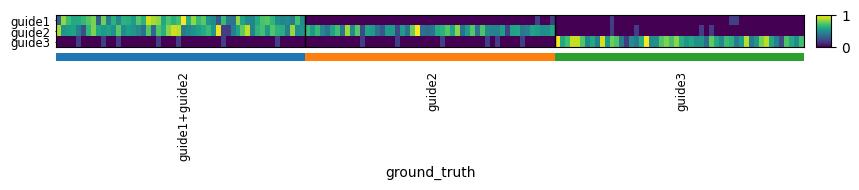
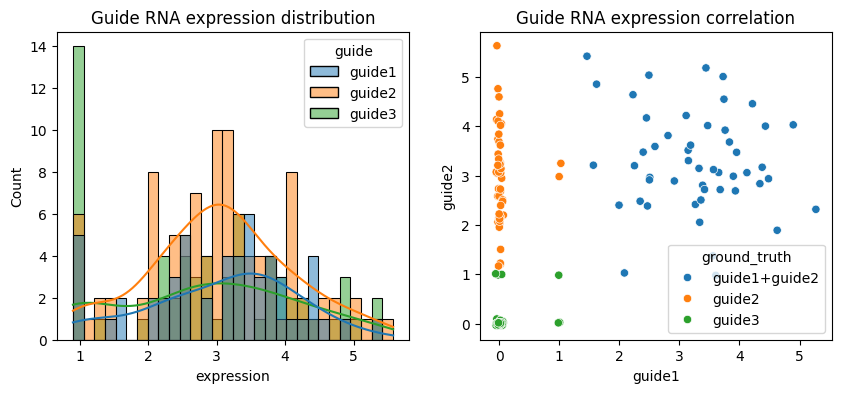
Let’s visualize the data more directly:
df = adata.to_df().stack().reset_index().rename(columns={"level_0": "cell", "level_1": "guide", 0: "expression"})
import seaborn as sns
from matplotlib import pyplot as plt

fig, axs = plt.subplots(1, 2, figsize=(10, 4))
df = df[df.expression > 0]
sns.histplot(df, x="expression", hue="guide", bins=30, kde=True, ax=axs[0])
axs[0].set_title("Guide RNA expression distribution")
df = adata.to_df()
df = np.random.default_rng().normal(0, 0.03, df.shape) + df  # Add jitter
sns.scatterplot(data=df, x="guide1", y="guide2", hue=adata.obs["ground_truth"], ax=axs[1])
axs[1].set_title("Guide RNA expression correlation")
plt.show()
Mixture model#
We can use the assign_mixture_model functionality for guide assignment.
For each guide, this function fits a Poisson-Gaussian mixture model to the data and assigns each cell to the guide with the highest probability.
The model assumes that the negative populations are Poisson-distributed and the positive populations are Gaussian-distributed. Notably, this model is able to assign cells as negative for any guide or multiple guides, which is useful for quality control and in case of low and high MOIs.
ga = pt.pp.GuideAssignment()
ga.assign_mixture_model(adata, assigned_guides_key="assigned_guide_mixture_model")
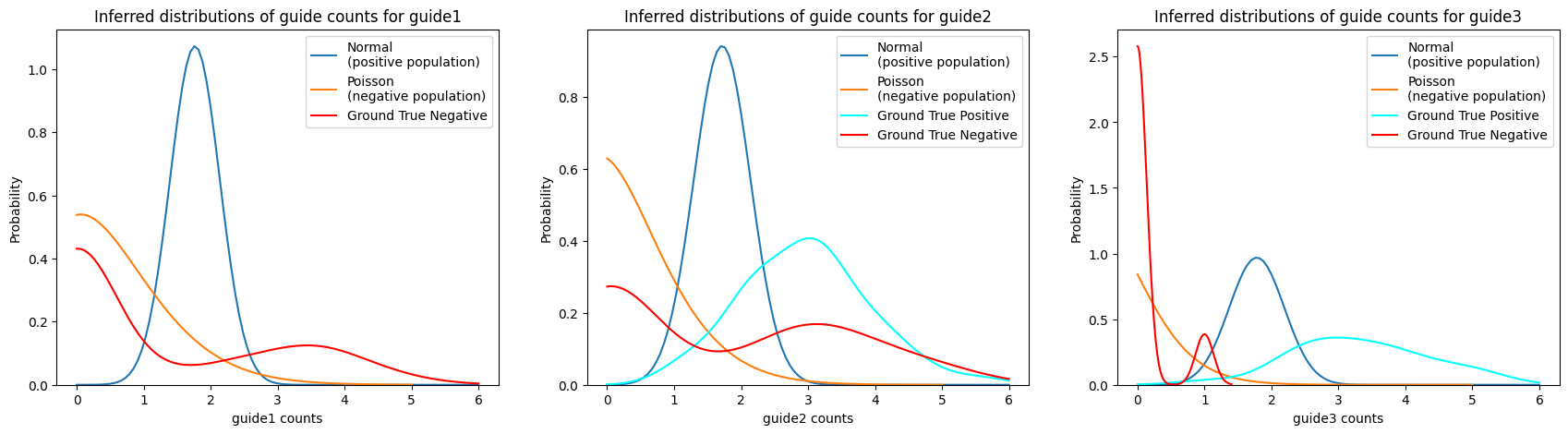
We can compare the actual vs the inferred guide expression for each cell:
import numpyro.distributions as dist

# plot probability distributions of model
n_guides = len(adata.var_names)
guides = adata.var_names
fig, axs = plt.subplots(1, n_guides, figsize=(7 * n_guides, 5))
for ax, guide in zip(axs, guides):
    # plot gaussian distribution
    x = np.linspace(0, 6, 100)
    y = dist.Normal(
        adata.var.loc[guide, "gaussian_mean"],
        adata.var.loc[guide, "gaussian_std"],
    ).log_prob(x)
    ax.plot(x, np.exp(y), label="Normal\n(positive population)")
    # plot poisson distribution
    x = np.linspace(0, 5, 100)
    y = dist.Poisson(adata.var.loc[guide, "poisson_rate"]).log_prob(x)
    ax.plot(x, np.exp(y), label="Poisson\n(negative population)")

    # Plot ground truth empirical distribution
    sns.kdeplot(
        np.ravel(adata[adata.obs.ground_truth == guide, guide].X),
        color="cyan",
        label="Ground True Positive",
        ax=ax,
        clip=(0, 6),
    )
    sns.kdeplot(
        np.ravel(adata[adata.obs.ground_truth != guide, guide].X),
        color="red",
        label="Ground True Negative",
        ax=ax,
        clip=(0, 6),
    )

    ax.set_xlabel(f"{guide} counts")
    ax.set_ylabel("Probability")
    ax.legend()
    ax.set_title(f"Inferred distributions of guide counts for {guide}")

plt.show()
Since we know which cell is supposed to be positive for which guide, we can evaluate the performance of the guide assignment method. We can calculate the accuracy, precision, recall, and F1 score for each guide, and visualize the confusion matrix:
from sklearn.metrics import accuracy_score, confusion_matrix, f1_score

accuracy = accuracy_score(adata.obs["ground_truth"], adata.obs["assigned_guide_mixture_model"])
f1 = f1_score(adata.obs["ground_truth"], adata.obs["assigned_guide_mixture_model"], average="weighted")

labels = np.unique(adata.obs["assigned_guide_mixture_model"])
cm = confusion_matrix(adata.obs["ground_truth"], adata.obs["assigned_guide_mixture_model"], labels=labels)
cm = pd.DataFrame(cm, index=labels, columns=labels).loc[adata.obs["ground_truth"].unique()]
ax = sns.heatmap(cm.T, annot=True, fmt="d", cmap="viridis")
ax.set_ylabel("Predicted")
ax.set_xlabel("Ground Truth")
plt.title(f"Confusion matrix\nAccuracy: {np.round(accuracy, 2)}, F1 score: {np.round(f1, 2)}")
plt.show()
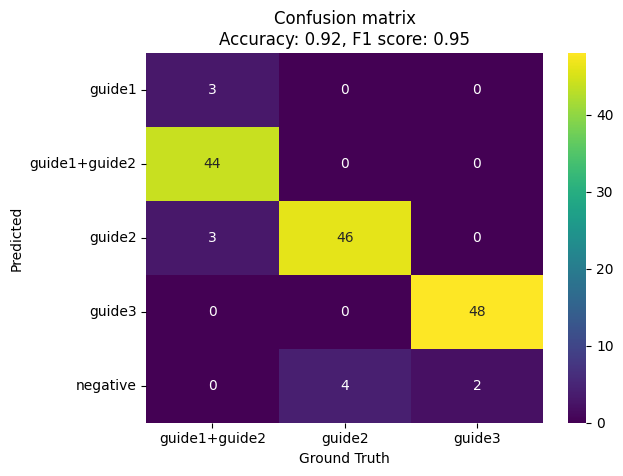
Threshold model#
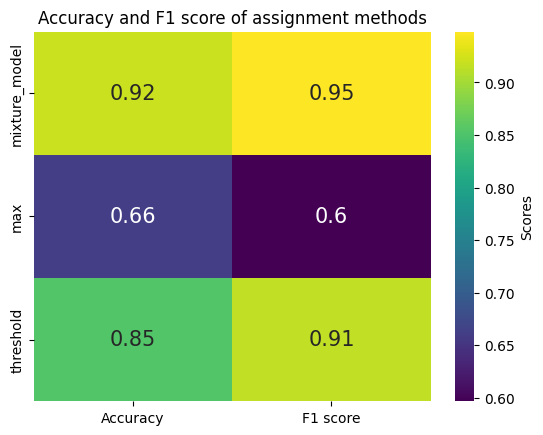
We can also assign guides using a threshold or maximum and compare the results:
ga.assign_by_threshold(adata, assignment_threshold=1, output_layer="assigned_guide_threshold")
ga.assign_to_max_guide(adata, assignment_threshold=1, obs_key="assigned_guide_max")

# Convert the threshold assignment to a string
matrix = adata.layers["assigned_guide_threshold"]
result = []
for row in np.asarray(matrix):  # Convert to a standard 2D array
    indices = [f"guide{i + 1}" for i, val in enumerate(row) if val == 1]
    result.append("+".join(indices) if indices else None)
adata.obs["assigned_guide_threshold"] = result
adata.obs.loc[adata.obs["assigned_guide_threshold"].isna(), "assigned_guide_threshold"] = "Negative"
evaluation = {}
for key in ["assigned_guide_mixture_model", "assigned_guide_max", "assigned_guide_threshold"]:
    evaluation[key] = (
        accuracy_score(adata.obs["ground_truth"], adata.obs[key]),
        f1_score(adata.obs["ground_truth"], adata.obs[key], average="weighted"),
    )
df = pd.DataFrame(evaluation, index=["Accuracy", "F1 score"]).T
df.index = df.index.str.replace("assigned_guide_", "")
sns.heatmap(df, annot=True, cmap="viridis", annot_kws={"size": 15}, cbar_kws={"label": "Scores"})
plt.title("Accuracy and F1 score of assignment methods")
plt.show()
fig, axs = plt.subplots(1, 3, figsize=(4 * 3, 4), sharey=True)
for ax, key in zip(axs, ["assigned_guide_mixture_model", "assigned_guide_max", "assigned_guide_threshold"]):
    gt_labels = adata.obs["ground_truth"].unique()
    pred_labels = adata.obs[key].unique()
    all_labels = np.union1d(gt_labels, pred_labels)

    cm = confusion_matrix(adata.obs["ground_truth"], adata.obs[key], labels=all_labels)
    cm = pd.DataFrame(cm, index=all_labels, columns=all_labels)
    cm = cm.loc[gt_labels, pred_labels]

    sns.heatmap(cm, annot=True, fmt="d", cmap="viridis", ax=ax)
    ax.set_ylabel("Ground Truth")
    ax.set_xlabel("Predicted")
    ax.set_title(f"Confusion matrix for\n{key}")
    plt.setp(ax.get_yticklabels(), rotation=0)

plt.tight_layout()
plt.show()
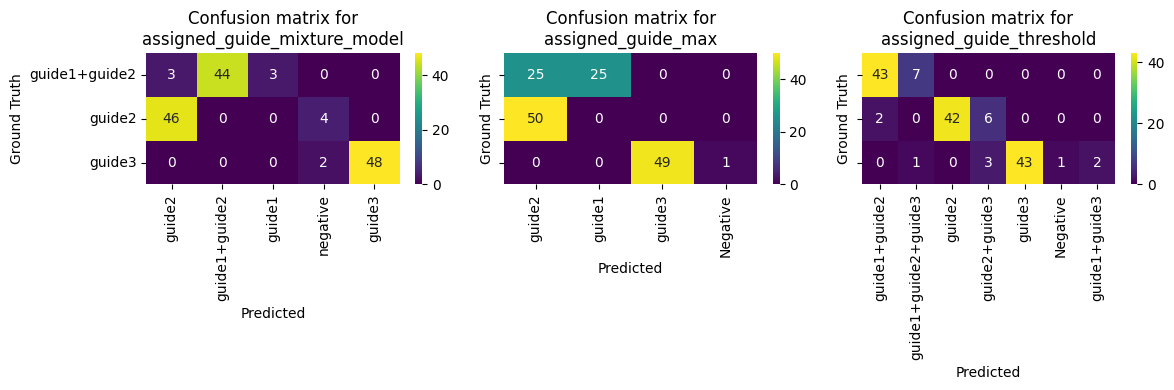
We can see that the mixture model approach is more robust to noise and can handle more complex data distributions. The max approach is less robust and may not work well in real data with mixed populations.
Real Data#
All guides should be available as a separate AnnData object containing counts of each guide for each cell.
The var_names of the AnnData correspond to the ID of these guides. In this example the ‘gdo’ modality contains guide RNA expression values.
Let’s load the Papalexi dataset. We will try to reproduce the guide assignment of the dataset.
mdata = pt.dt.papalexi_2021()
# seems like an error in the original data
mdata.mod["gdo"].X = scipy.sparse.csr_matrix(mdata.mod["gdo"].X.toarray() - 1)
gdo = mdata.mod["gdo"]
gdo
AnnData object with n_obs × n_vars = 20729 × 111
    obs: 'orig.ident', 'nCount_RNA', 'nFeature_RNA', 'nCount_HTO', 'nFeature_HTO', 'nCount_GDO', 'nCount_ADT', 'nFeature_ADT', 'percent.mito', 'MULTI_ID', 'HTO_classification', 'guide_ID', 'gene_target', 'NT', 'perturbation', 'replicate', 'S.Score', 'G2M.Score', 'Phase'
    var: 'name'
Then we save the original count values and transform the data using log transformation.
gdo.layers["counts"] = gdo.X.copy()
sc.pp.log1p(gdo)
gdo
AnnData object with n_obs × n_vars = 20729 × 111
    obs: 'orig.ident', 'nCount_RNA', 'nFeature_RNA', 'nCount_HTO', 'nFeature_HTO', 'nCount_GDO', 'nCount_ADT', 'nFeature_ADT', 'percent.mito', 'MULTI_ID', 'HTO_classification', 'guide_ID', 'gene_target', 'NT', 'perturbation', 'replicate', 'S.Score', 'G2M.Score', 'Phase'
    var: 'name'
    uns: 'log1p'
    layers: 'counts'
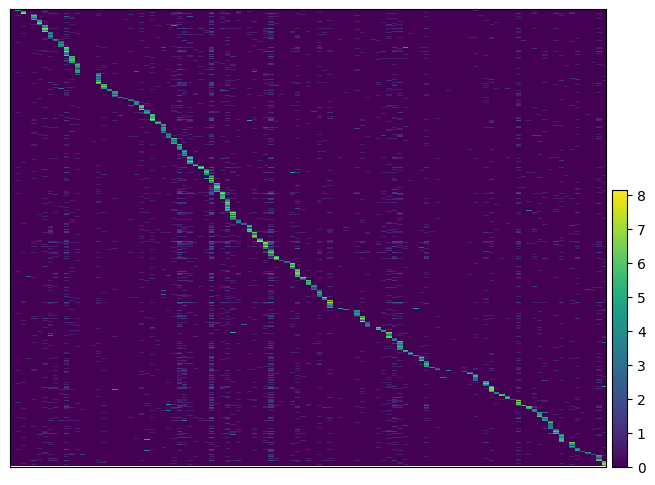
We can visualize the expression of guides per cells to get more insight. By passing the argument key_to_save_order to the function, the order of cells in the plot will be saved in obs of the data.
ga = pt.pp.GuideAssignment()
ga.plot_heatmap(gdo, key_to_save_order="plot_order")
WARNING: Gene labels are not shown when more than 50 genes are visualized. To show gene labels set `show_gene_labels=True`
Most frequent guide#
We can also assign to the guide RNA with the highest detection:
ga = pt.pp.GuideAssignment()
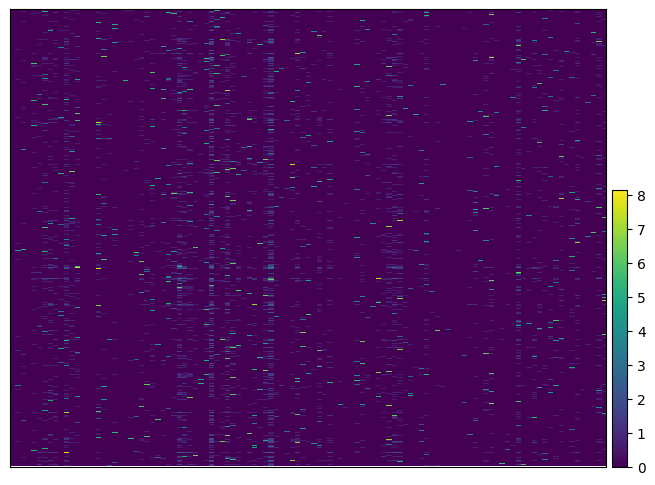
ga.assign_to_max_guide(gdo, assignment_threshold=5, layer="counts")
As we see it completely maches the guide assignment in the mixscape pipeline:
sum(gdo.obs["assigned_guide"] != gdo.obs["guide_ID"])
0
ga.plot_heatmap(gdo, order_by="plot_order")
WARNING: Gene labels are not shown when more than 50 genes are visualized. To show gene labels set `show_gene_labels=True`
/home/lukas/miniforge3/envs/pertpy/lib/python3.12/site-packages/anndata/_core/anndata.py:1158: ImplicitModificationWarning: Trying to modify attribute `.obs` of view, initializing view as actual.
  df[key] = c
Mixture model#
We will heavily subset the original dataset so this can run on CPU as well in a reasonable time.
gdo_schmol = gdo[:5000, :10].copy()
gdo_schmol.X = gdo_schmol.layers["counts"].copy()
ga = pt.pp.GuideAssignment()
ga.assign_mixture_model(gdo_schmol, assigned_guides_key="assigned_guide_mixture_model", show_progress=True)
/tmp/ipykernel_1394313/359173462.py:2: UserWarning: Skipping eGFPg1 as there are less than 2 cells expressing the
guide at all.
  ga.assign_mixture_model(gdo_schmol, assigned_guides_key="assigned_guide_mixture_model", show_progress=True)
import seaborn as sns

pdf = (
    gdo_schmol.obs[["guide_ID", "assigned_guide_mixture_model"]]
    .value_counts()
    .reset_index()
    .rename(columns={0: "count"})
    .pivot(index="guide_ID", columns="assigned_guide_mixture_model", values="count")
    .fillna(0)
)
fitted_guides = np.intersect1d(gdo_schmol.var_names, pdf.index)
spdf = pdf.loc[fitted_guides, fitted_guides]
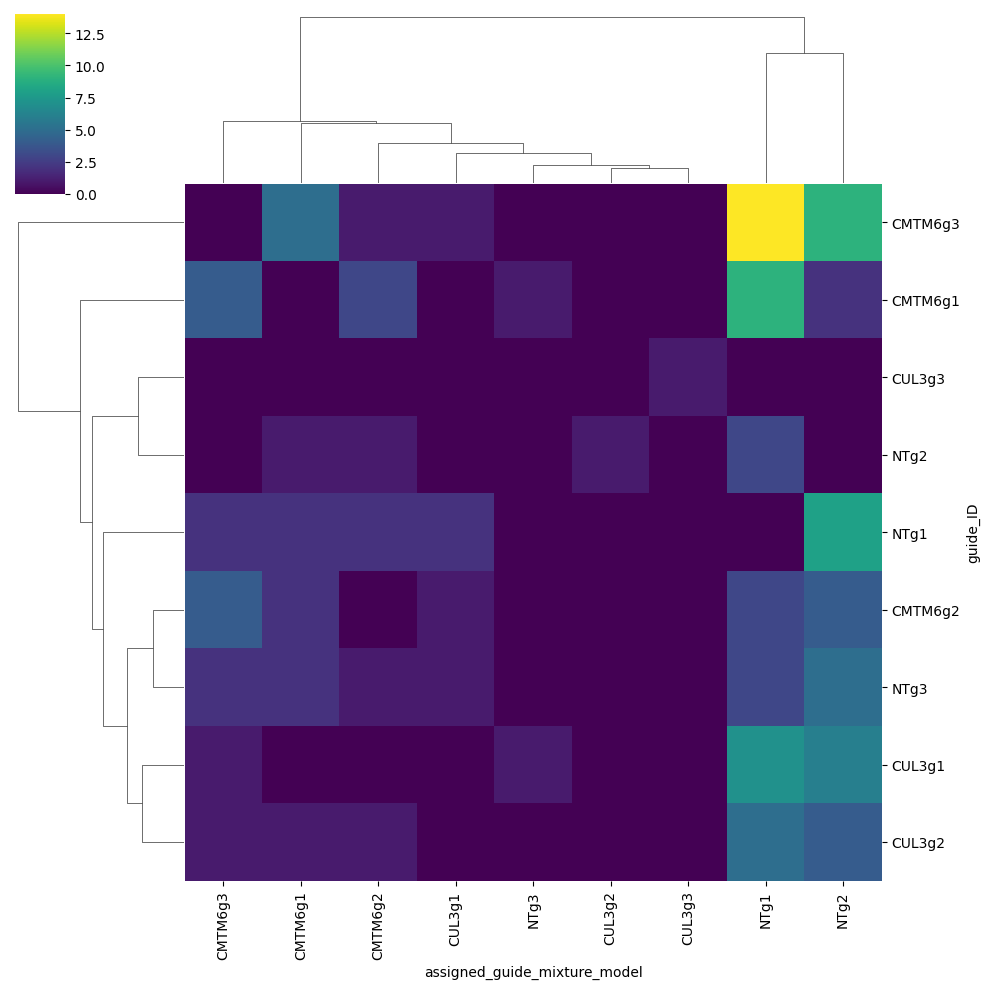
sns.clustermap(spdf, cmap="viridis")
<seaborn.matrix.ClusterGrid at 0x7308cc33a360>